
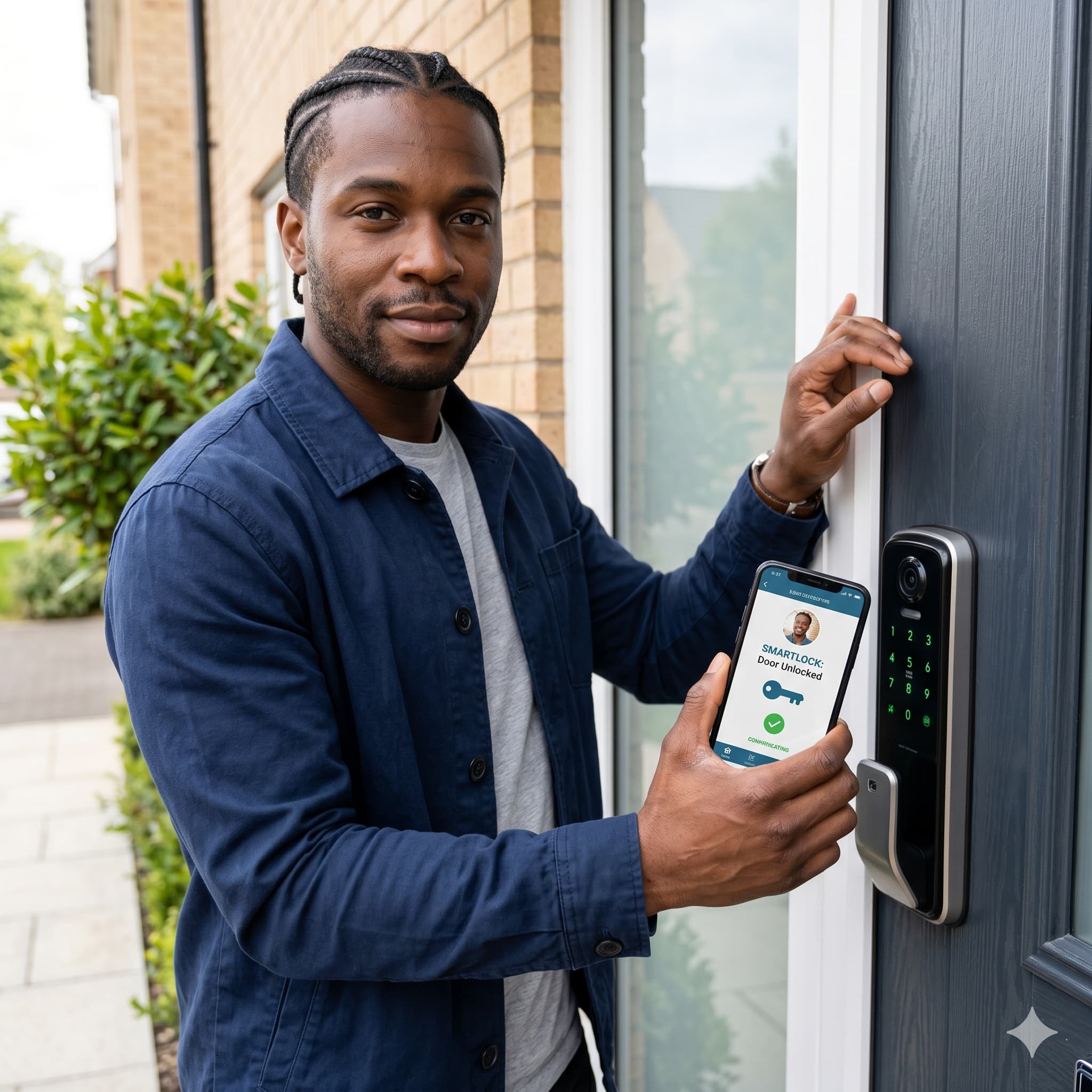
You replaced your deadbolt with a $250 smart lock. You can let in the dog walker from your phone, set access codes for contractors, and check whether the back door is locked before you go to bed. None of that makes your door harder to kick in. A smart lock on a weak door frame is still a weak door frame.
Smart locks are real products with real value — but that value is almost entirely about convenience, not physical security.
What Smart Locks Do (and Do Not Do)
A smart lock replaces or augments your deadbolt mechanism with one that responds to a code, a phone, a fingerprint, or a combination. The lock itself — the physical bolt and the strike plate — is typically the same quality as a standard deadbolt at the same price point.
What smart locks add: keyless entry, remote locking and unlocking, temporary access codes for guests or contractors, entry logs showing who used the lock and when, and integration with smart home systems. These are genuinely useful features.
What smart locks do not add: a stronger bolt, a better strike plate, a more reinforced door frame. More than 90% of residential door break-ins involve the frame, not the lock — a kick door forces the strike plate out of a soft wood frame regardless of how sophisticated the lock mechanism is. The Schlage B60N deadbolt at $35 provides the same physical resistance as most $200 smart locks, because the physical bolt is the same design.
—
> Most residential break-ins use force against the door frame, not picking or bypassing the lock. Upgrading to a smart lock without reinforcing the frame does not meaningfully improve your physical security.
—
The Actual Security Risks Smart Locks Introduce
Smart locks add attack surfaces that a deadbolt does not have. A standard deadbolt can only be compromised by someone physically at the door with a pick, a bump key, or a boot. A smart lock can theoretically be compromised remotely if the software is vulnerable, if your network is compromised, or if your phone is stolen and your apps are unlocked.
In practice, remote hacking of consumer smart locks is extremely rare. Residential burglars are not running exploits against your Z-Wave network. But it is worth understanding that smart locks expand the attack surface even if that expansion is small.
More practically: smart locks depend on batteries. Most provide low-battery warnings, but a dead battery can lock you out. This is a reliability issue, not a security one — but it is a real operational downside.
When Smart Locks Are Worth It
If you regularly need to grant temporary access — to cleaners, dog walkers, contractors, houseguests — smart locks pay for themselves in the reduction of key duplication and the ability to revoke access remotely. You can give a contractor a 6-hour window code instead of a copy of your key.
If you have a system where the lock integrates with other devices — lights turning on when the door unlocks, security camera arming when you leave — the smart home value is real.
If you frequently find yourself locked out or carrying too many keys, the convenience value is straightforward.
—
> Smart locks earn their cost through access management — temporary codes, remote control, and entry logs. If you do not regularly need those features, the $150 to $250 premium over a standard deadbolt is hard to justify on security grounds alone.
—
What Actually Makes a Door More Secure
If physical security is your goal, the highest-value upgrades are below the lock:
Replace the strike plate. Most doors use a cheap 2-inch strike plate held in with 3/4-inch screws into the door casing. Replace it with a 6-inch reinforced strike plate secured with 3-inch screws going into the stud. This single $15 upgrade has a dramatic effect on how much force is required to kick the door in.
Reinforce the door frame itself. Katy Security makes frame reinforcement kits that are widely used by security professionals. Total cost: $60–$100.
Use a Grade 1 or Grade 2 deadbolt. ANSI Grade 1 deadbolts (Schlage, Medeco, Kwikset SmartKey in the higher tiers) provide meaningful pick and bump resistance. A Grade 1 deadbolt at $60 provides better physical security than most $200 smart locks.
A smart lock on a reinforced frame and quality deadbolt makes your door both convenient and secure. A smart lock on an unreinforced door is an expensive cosmetic upgrade.
Questions Homeowners Ask
- What do you actually need in a home security system?
- DIY vs. professional home security installation
- The real cost of a home security system
Find the Right Home Security Setup for Your Home
Compare systems, smart locks, and cameras before you buy.

Leave a Reply