
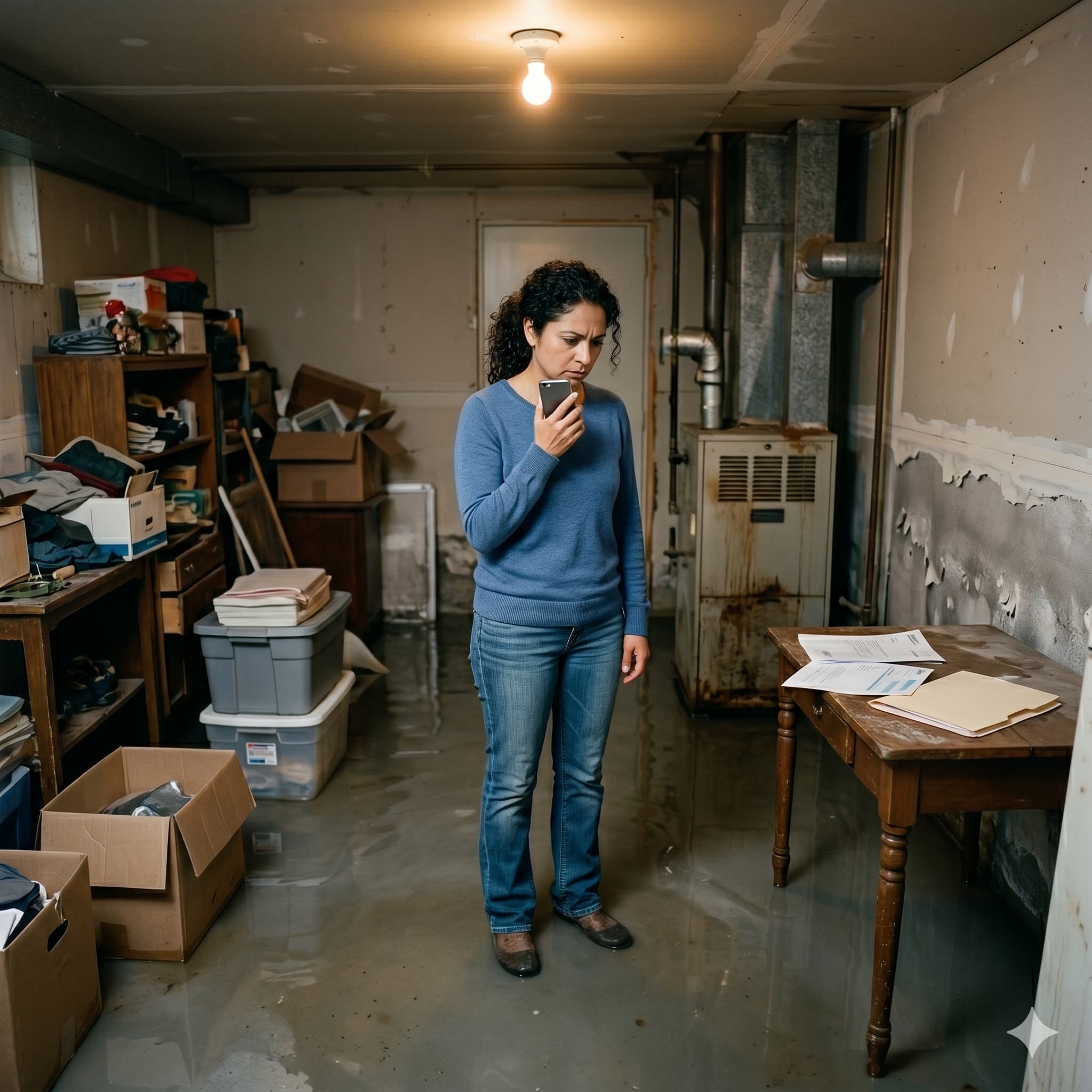
Your basement flooded after three inches of rain in one afternoon. You called your insurance company. The adjuster told you that flooding from surface water is not covered under a standard homeowners policy — that is a separate product called flood insurance, and you do not have it. The damage total is $34,000. You are on the hook for all of it.
This is not a rare situation. It happens to thousands of homeowners every year because standard homeowners insurance has a well-defined list of excluded perils, and most policyholders do not know what is on it until they file a claim. By then, the moment to do something about it has passed.
Here is what standard homeowners insurance does not cover and what products exist to fill each gap.
Flooding: The Most Expensive Misunderstanding in Homeowners Insurance
Standard homeowners insurance covers water damage from a sudden internal event — a burst pipe, an overflowing appliance, an accidental discharge. It does not cover flooding from external water sources. This includes storm surge, river overflow, heavy rain that overwhelms drainage systems, and water that enters from the ground up. The source matters more than the damage itself.
Flood insurance is a separate product, primarily through the National Flood Insurance Program administered by FEMA, though private flood carriers also exist. Coverage under the NFIP maxes out at $250,000 for the structure and $100,000 for contents. Private carriers can offer higher limits and broader coverage in some cases.
The critical detail: NFIP flood policies have a 30-day waiting period before coverage takes effect. You cannot buy flood insurance when a hurricane is three days away. If you are in a flood-prone area or your property sits near any body of water, this is not a coverage decision to defer. According to FEMA, just one inch of water in a home can cause more than $25,000 in damage.
Earthquakes: Excluded Everywhere Unless You Add It
Earthquake damage is excluded from standard homeowners policies in all 50 states. This surprises many homeowners outside California, who assume earthquakes are someone else’s problem. In fact, 45 states have experienced earthquakes in the past 30 years, and several Midwestern and Southeastern states have meaningful seismic risk that most homeowners have not accounted for.
Earthquake coverage is available as a standalone policy or an endorsement to your existing homeowners policy depending on your carrier and state. In high-risk areas like California, standalone earthquake policies through the California Earthquake Authority or private carriers are the most common path. Deductibles on earthquake policies are typically a percentage of your home’s insured value — often 10 to 25 percent — rather than a flat dollar amount, which means a $400,000 home may have a $40,000 to $100,000 out-of-pocket threshold before coverage applies.
Sewer and Drain Backup: A Common Exclusion That Catches Homeowners Off Guard
When a sewer line backs up into your basement — a not-uncommon event in older homes and neighborhoods with aging municipal infrastructure — standard homeowners insurance does not cover it. Water that enters your home from the municipal sewer system or a backed-up drain is excluded from most base policies.
Sewer and water backup coverage is typically available as an inexpensive endorsement to your existing homeowners policy, often adding $50 to $150 per year in premium for $10,000 to $25,000 in coverage. Given that a sewer backup cleanup can cost $5,000 to $20,000 depending on the extent of contamination and structural involvement, this is one of the highest-value low-cost endorsements available to homeowners in older homes or areas with aging sewer infrastructure.
Mold, Wear and Tear, and Gradual Damage
Homeowners insurance covers sudden, accidental damage. It does not cover damage that develops gradually or results from deferred maintenance. A roof that fails after fifteen years of normal wear is not a covered loss — that is a maintenance issue. A slow leak behind a wall that causes mold growth over six months is typically not covered because it was not sudden or accidental.
Mold coverage varies significantly by policy. Some policies include limited mold remediation coverage; others exclude mold entirely. Read your policy’s mold language before you need it. If mold coverage is absent or insufficient, standalone mold endorsements are available from some carriers in high-humidity markets.
The practical implication is that deferred maintenance is always an uninsured risk. A water heater that has been showing signs of failure for two years and finally gives out is likely to generate a claim dispute about whether the damage was sudden or the result of neglect. Document your maintenance and address problems promptly.
High-Value Personal Property: Jewelry, Art, Collectibles, and Electronics
Standard homeowners policies include personal property coverage, but it comes with sublimits on specific categories. Jewelry is commonly capped at $1,500 to $2,500 for theft. Firearms, art, silverware, musical instruments, and electronics each have their own sublimits that may be far below the actual value of items you own.
A scheduled personal property endorsement — sometimes called a floater — allows you to insure specific high-value items at their full appraised value. The cost depends on the item category and insured value, but covering a $10,000 engagement ring typically costs $100 to $200 per year. For homeowners with collections, valuable instruments, or significant jewelry, reviewing the sublimits in your base policy against your actual possessions is a necessary exercise.
Home-Based Business Equipment and Liability
If you run a business from your home — even part-time — your standard homeowners policy provides minimal protection for it. Business equipment is typically covered up to $2,500 under most policies, and business liability is excluded entirely. If a client visits your home office and is injured, your homeowners liability coverage may not apply because the incident occurred in a business context.
A home-based business endorsement or a separate business owner’s policy addresses both the equipment and liability exposure. This matters increasingly as remote and home-based work has become common. Review your policy’s business activity exclusions if any part of your livelihood involves your home.

Leave a Reply